ラベル Christmas の投稿を表示しています。 すべての投稿を表示

2017-01-13

Practice Conversation -- New Years and Winter Holiday

[JMR Posted February 6th. Should have been posted early in January.]
 
At the airport, Nanami is heading home for winter vacation:

Alice: Do you have everything, love?

Nanami: Just my backpack and my carry-on bag.
  It really is okay if I leave everything else?

Alice: It's no problem, love.
  It won't be in our way.

Art: Don't worry 'bout it, mate.
  It'll all be waiting here for you when you get back.

Christopher: I promise I’ll stay out of your stuff!

Julie: If he so much as peeks into your room,
  I’ll take his head off!

Christopher: Mom! She’s threatening me again!

Alice: Oh, behave yourselves.
  There’s your flight, Nana.
  Take care of yourself.

Nanami: Thanks for everything.
  Goodbye. I’ll see you in two weeks.

Art: Have a merry!

Nanami: Everybody have happy holidays!

Julie: See you next year!

Christopher: Take care!

At the airport, two weeks later, Nanami is returning to her home stay family after winter vacation:

Christopher: There she is!

Nanami: Alice!

Alice: Nana, love! Over here!

Nanami: Art, Julie, Christopher, Happy New Year!

Christopher: Oh. Yeah. Happy new year.
  You missed the fireworks.

Julie: Ignore my brother. Happy New Year, Nana! 
  How were your holidays?

Nanami: I had a wonderful time at home.
  But I'm glad to be back.

Alice: Tell us about it on the way.
  We must have your family come visit sometime.

Art: Indeed.  Got your stuff? Let's go.

2016-12-31

PTA English December Notes -- Christmas Party, with Games

I didn't get these notes done before the end of the year this time, either.
[get ... done => …を済ます(済ませる)]
[before the end of ... => …内]
[this time => 今度]
[either => どちらも、これでも(今度も)]

We met in one of the electives classrooms, to give us more room for the party.
[meet => 集合する (meet met met)]
[one of ... => …の一つ]
[elective => 選択教科]
[more room => (場所などの)余裕]
[to give us more room for ... => …のための余裕ができるように]

We played three word games in English, for practice.
[word game => (しりとりなどのような)言葉遊び]

  • First, we played the game we played last time, "Never have I ever ...."
    [the game {that} we played {the} last time => 先ほどやったゲーム]
  • Then we played a variation of "Matthew, Mark, Luke, and John", using numbers instead of books of The New Testament in The Bible.
    [variation => 形を変えたもの]
    [instead of ... => …のかわりに]
  • After that, we played "The Minister's Cat".
    [minister => 牧師、お僧、大臣など]
At the end, we exchanged presents by drawing lots. I should have left more time to talk about the presents, I think. Sorry about that.
[exchange => 交換する]
[drawing lots => くじを引くこと]
[should have ... => …にしたほうが良かった]
[leave time => (予定に)時間をあける]


Never Have I Ever


The rules are in the notes for the previous lesson, but I'll summarize them here:
[summarize => 短くまとめる]

(This game is also on Wikipedia.)
  • Everyone holds up ten fingers.
    [hold up ... => …を上に持つ、出す]
  • Each turn goes like this:
    [turn => 番、当番]
    [... goes like this => こういうふうに行く、こんな感じでやる]
    1. The person whose turn it is tells something he or she has never done:
      [tell => おしえる、話をする] [something ... has never done => …は、やったことごないもの]
      Never have I ever _____.
    2. Everyone who has done that thing folds one finger down.
      [everyone who has ... => …をやったことがあるみな]
    3. Anyone who has folded all ten fingers down is out. 
      [anyone who has ... => …をやったことがあるだれでも]
      [fold down => 下ろす]
      [out => 負けた(状態)]
  • The last person with fingers remaining up wins.
    [fingers remaining up => 指が立ったまま残っている]
[解釈は先月のノートをご参考下さい。]

The unusual grammar is for emphasis:
[unusual => 変わった、普通ではない]
[grammar => 文法]
[emphasis => 強調]
[=> 珍しい文法は強調のためです。]
  • I have never flown like a bird.
    [鳥のように飛んだことが一度もない。]
  • I have never ever flown like a cat.
    [猫みたいに飛んだ(或いは逃げ出した)ことは絶対に無い。]
  • Never have I flown like an airplane.
    [一度も飛行機みたいになって飛んだことがない。]
  • Never have I ever flown like a banana.
    [バナナのように飛んだことは一切に、絶対にありません。]
[fly => 飛ぶ、逃げ去る (fly, flew, flown)]
[coop => かご、おり、小屋 (chicken coop == 鶏小屋)]
[fly the coop => おりを羽ばたいて逃げる]

[put/fold a finger down => 指をおる ("bend"はここではあんまり使わない。)]

helicopter (fly, flew, flown)
Never have I ever flown in a helicopter.
ghost (see, saw, seen)
Never have I ever seen a ghost.
pony [子馬] (ride, rode, ridden)
Never have I ever ridden a pony.
Korea -- day trip (go, went, gone)
Never have I ever gone on a day trip to Korea.
cruise around the world
Never have I ever gone on a cruise around the world.
tequila [テキーラ] (drink, drank, drunk)
Never have I ever drunk tequila.
snowboard (ride, rode, ridden)
Never have I ever ridden on a snowboard.
Never have I ever gone snowboarding.
viola [楽器のヴィオラ] (play)
Never have I ever played the viola.
Aomori
Never have I ever gone to Aomori.
diamond [ダイヤモンド:(ダイ・モンド)] (buy, bought, bought)
Never have I ever bought a diamond.
Dubai Atlantis Hotel (stay)
Never have I ever stayed at the Atlantis Hotel in Dubai.
[Dubai => ドバイ]]
[United Arab Emirates => アラブ首長国連邦]
scuba diving [スキューバ] (go, went, gone)
Never have I ever gone scuba diving.
St. Nick (Saint Nicholas) / Santa Claus (meet, met, met)
Never have I ever met St. Nick.
Iceland
Never have I ever gone to Iceland.


Matthew, Mark, Luke, and John


This is a group game useful for memorizing lists. The name comes from the list of names of books of the New Testament (in the Bible), which is not easy to memorize. But it can be used for other lists, like numbers in English or Japanese.
[group game => グループで遊ぶゲーム]
[memorize => 覚える、暗記する]
[comes from ... => …由来]
[can be used for ... => …にも使ってもいい]

(This is a simple game. It's a lot easier to play than to explain. If you are not embarrassed to be seen, practice while you read the description. That makes it simple to follow along.)
[easier to play than to explain => 説明するよりはやるのが簡単]
[not embarrassed to ... => …に恥ずかしくない]
[pratice while ... => …しながら練習する]
[description => 描写、説明]
[makes it simple to ... => …をやりやすくする]
[follow along => ついていく]

Everyone should sit in a circle.
[輪になって座る]

The rhythm is counted in four.
[四拍子のリズムです。]

The leader should show the rhythm. Clap your hands twice on your knees on one and two, then once together in front of you, then rest:
[clap hands on knees => 膝に手拍子]
[clap on one and two => 1、2に拍子を]
[clap hands together => 手を併せて手拍子]
[in front of ... => …の前に]
[rest on four => 4に音を鳴らさない]
Clap (knees), clap (knees), clap (hands), rest. 

After demonstrating the clapping twice or so, have everyone practice the rhythm in unison once or twice.
[in unison => 皆揃って、一致して、同度に]

Now demonstrate the rhythm, saying the first word in the list on the third count, then the second word, then the third, then fourth:
[saying ... => …を唱えて]
Clap (knees), clap (knees), clap (hands) -- "Matthew", rest.
Clap (knees), clap (knees), clap (hands) -- "Mark", rest.
Clap (knees), clap (knees), clap (hands) -- "Luke", rest.
Clap (knees), clap (knees), clap (hands) -- "John", rest.

If you are doing it with numbers, it will be
[数字の場合]
Clap (knees), clap (knees), clap (hands) -- "one", rest.
Clap (knees), clap (knees), clap (hands) -- "two", rest.
Clap (knees), clap (knees), clap (hands) -- "three", rest.
Clap (knees), clap (knees), clap (hands) -- "four", rest.

Then have everyone practice the first part of the list in unison. If the list is hard for some in the circle, you may want to practice the whole list in unison.
[the first part of the list => リストの頭部の何個]
[if ... is hard => …が難しかったら]
[for some => 何人かにとって]
[you may want to ... => …が望ましいかも知らない]
[whole list => リスト全体("whole"と"hole"は同音意義です。)]

Next, have everyone in the circle number off, starting with the leader -- The leader is Matthew, the next person to the right is Mark, the next is Luke, and so on. Or, if using numbers, the leader is one, the person to the right is two, etc.
[have everyone ... => 皆に…をやってもらう]
[number off => 順に追って唱える]
[next to the right => 右の人]

(Or you might use ordinals: "first", "second", "third", etc. Any list of words will work.)
[ordinals => 序数]
[work => 巧く行く、適用できる]
[any will work => どれでもいける]

A list of books of the New Testament (more information here) is as follows:

  1. Matthew [マ・シュー]
  2. Mark [マーク]
  3. Luke [ルーク]
  4. John [ジョン]
  5. Acts [アックツ]
  6. Romans [ロー・マンズ]
  7. Corinthians (1st & 2nd) [コ・リン・シ・アンズ]
  8. Galatians [ガ・レー・シャンズ]
  9. Ephesians [エ・フィー・ジャンズ]
  10. Philippians [フィ・リ・ピ・アンズ]
  11. Colossians [コ・ロー・ジ・アンズ]
  12. Thessalonians (1st & 2nd) [テ・セ・ロー・ニ・アンズ]
  13. Timothy (1st & 2nd) [ティ・モ・シー]
  14. Titus [タイ・タス]
  15. Philemon [フィ・レ・モン]
  16. Hebrews [ヒー・ブルーズ]
  17. James [ジェームズ]
  18. Peter (1st & 2nd) [ピー・ター]
  19. John (1st, 2nd, & 3rd) [ジョン]
  20. Jude [ジュード]
  21. Revelation [レ・ヴェ・レー・ション]
If you have more than twenty-one in the circle, you can use First and Second Corinthians, etc., but that requires speaking very quickly.
[if more than ... => …より多い場合]
[First Corinthians => コリント人への第一の手紙]
[that requires ... => …が必要]
[quickly => 素早く]

One popular option is starting with Matthew, Mark, Luke, and John, then shifting to numbers, one, two, etc.:
[popular option => 人気ある別のやり方]
[start with ... => …として初めて]
[shift to ... => …に切り替える]

Matthew, Mark, Luke, John, one, two, three, ...

Now that everyone is comfortable with the list and the rhythm you might want to go around the circle one more time, in rhythm, everyone clapping, but only the person whose turn it is speaking his or her own name or number.
[now that ... => …になっていて]
[everyone is comfortable with ... => 皆が…に慣れてきている]
[you might want to ... => …にしてもいいかも知らない]
[go around one more time => もう一回周る]
[in rhythm => 拍子に乗って]
[everyone clapping => 皆拍子を鳴らして]
[person whose turn it is => 順番の人]
[only ... speaking => …のみが唱えて]
[his or her own => 自分の]

Now you are ready for the beginners' level game.
[beginners' level => 初心者のやり方]

The leader starts the rhythm, with everyone clapping. On the third count, he says the name or number of the next person to lead.
[on the third count, he says ... => 3に…を唱える]
[... of the next person => 次の人の…]

Without breaking rhythm, the new leader names the next person to lead, and so on.
[without breaking the rhythm => 拍子を外さず]

When someone misses, everyone stops, and then that person starts the rhythm again.
[when ... misses => …がミスを起こすと]
[that person => (ミスを起こした)その人]

When everyone feels comfortable with the first level, take it up a level. At this level, the leader is not silent on the first two counts, but says his own name or number. :
[take it up a level => レベルをあげる]
[not silent => 黙ってはいない]
[says his own ... => 自分の…を唱える]
Matthew: Clap, "Matthew"; clap, "Matthew"; clap "Mark"; rest.
if Matthew picks Mark to continue.
[picks ... to continue => 続く(人)に…を示す(当てる)]

Then, if Mark picks Acts to continue,
Mark: Clap, "Mark"; clap, "Mark"; clap, "Acts"; rest.
If Acts then picks Philippians, 
Acts: Clap, "Acts"; clap, "Acts"; clap, "Philippians"; rest.
And if Philippians then picks Galations,
Philippians: Clap, "Philippians"; clap, "Philippians"; clap, "Galations"; rest.

Doing that in numbers, 1, 2, 5, 10, 8, ...:
One: Clap, "one"; clap, "one"; clap, "two"; rest.

Two: Clap, "two"; clap, "two"; clap, "five"; rest.

Five: Clap, "five"; clap, "five"; clap, "ten"; rest.

Ten: Clap, "ten"; clap, "ten"; clap, "eight"; rest.
At the next level up, a person who misses the rhythm goes to the end of the circle, and everyone after that person moves up one, taking new names or numbers.
[a person who misses ... => …を外れる人]
[goes to the end => 末尾に移動する]
[everyone after that person => その(拍子を外れた)人の後の人皆]
[moves up one => 一つ頭の方へ]
[taking new names or numbers => 新しい(一の)名前や番号に変えて]

We did a round of using numbers so everyone could get used to it.
[round => 一回り]
[so everyone could get used to it => 慣れていけるように]

I suggested that, if starting from one is too easy, the list could start from eleven.
[suggest => 提案する、勧める]
[the list could start from ... => リストが(1の替りに)…から始まってもいいでしょう]


The Minister's Cat

(This game is also on Wikipedia.)

In Japanese, there is a game called "Taking the Tail", or 「尻取り」 (Shiritori). It's a word association game, where, in each turn, you think of a word that starts with the final 音 (on, loosely, syllabic character, or mora) of the previous word.
[there is ... => …はあるよ!]
[called ... => …という]
[tail => 末尾、尻尾]
[word association => 言葉の関連性]
[in each turn => 交代交代]
[think of ... => …を考えだす]
[starts with ... => …で始める]
[final ... => 末尾の…]
[syllabic > 音節の]
[mora => (かなの)泊、一つのかなの音]

There are English-language word games similar to Shiritori, called Word Chain games, in which you can start the next word with either the last sound or the last letter of the previous word.
[word game => 言葉で遊ぶゲーム、言葉遊び]
[similar to ... => …のような、…に似た]
[chain => 関連、関連性]
[in which ... => …になる、その中に…がある]
[can start with either A or B => A でも B でも始めてもいい]
[start the word with ... => …でその言葉を始める(その言葉が始める)]
[last sound => 最後の音(発音)]
[last letter => 末尾の文字]

There is also a game known as The Minister's Cat, in which you think of words to describe the cat according to their first letter.
[there is also ... => …もある]
[known as ... => …として知られる]
[minister => 牧師、僧、大臣]
[describe => 描写する、(想像できるように)説明する]
[according to ... => …に応じて、…に従って、…と一致して]
[first letter => 頭文字]

There are two versions. In the easy version, the first person says an adjective for the cat that starts with "A", the second thinks of a word that starts with "B", and so on, each player using the next letter of the alphabet in turn.
[easy version => やりやすいやり方、優しいバージョン、簡単版]
[adjective => 描写する語彙、形容詞]
[word that starts with ... => …で始める語彙]
[and so on => など]
[using ... => …をあてて]
[next letter in turn => 交代交代次の文字]

In the harder version, all players think of words that start with "A". When they have gone around the circle, or when no one can think of any more words, they start on words that begin with "B".
[harder => 難い、難しい]
[when they have gone around ... => …を回ったところ]
[no one can think of ... => 誰も…を考え出せない]
[any more ... => これ以上の…]
[start on ... => …でやりだす]

To make the game competitive, players who can't think of a word are out.
[make ... competitive => …を競争的にする]
[who can't think of ... => …を考え出せない]
[are out => 負けたものとする]

We played one round of the easy rules version of this game, in rhythm:


amicable
友好的な
The minister's cat is an amicable cat.
brilliant
天才ある
The minister's cat is a brilliant cat.
cute
可愛い
The minister's cat is a cute cat.
dangerous
危険な
The minister's cat is a dangerous cat.
elegant
気質のある、優美な、洗練された、品の良い
The minister's cat is an elegant cat.
foolish
思慮分別のない、愚かな
The minister's cat is a foolish cat.
giant
でかい、巨大な
The minister's cat is a giant cat.
happy
幸せな、嬉しい
The minister's cat is a happy cat.
innocent
無邪気な、無罪な
The minister's cat is an innocent cat.
(gentle は "j" ではなかった)
優しい、丁重な、物柔らかな
The minister's cat is a gentle cat.
jealous
嫉妬深い、ねたむ
The minister's cat is a jealous cat.
kind
親切な、思いやりのある、寛大な
The minister's cat is a kind cat.
luxurious
豪華な
The minister's cat is a luxurious cat.
(The minister's cat has luxurious fur.)
magical
魔法ある、魅力ある
The minister's cat is a magical cat.
(honest は "o" ではなかった)
味目で正直な、真実しか言わない
The minister's cat is an honest cat.
old
年老いた
The minister's cat is an old cat.
printed
印刷された(つまり、猫の絵か、猫の写真)
The minister's cat is a printed cat.


 [JMR: Actually posted January 2nd, 2017 -- had to preserve links.]

2016-12-16

Christmas Notes -- When Was Jesus' Birthday?

Makoto: Thanks for picking me up at the airport.

Tom: Oh, sure.

Makoto: Say, I heard something strange on the airplane.

Tom: Yeah?

Makoto: A woman behind me was telling the little girl beside her that nobody knows when Jesus' birthday really was.

Tom: Well, that's true. We don't.

Makoto: I thought it was December the twenty-fifth.

Tom: That's the date of a number of non-Christian winter festivals, actually.

Makoto: Then why is Christmas on December twenty-fifth?

Tom: It's a long story.

Makoto: No short version?

Tom: Hmm. Okay, for starters, you know that we don't have any hard evidence that the Biblical Jesus actually existed.

Makoto: I've heard that, but I thought it was just atheist arguments.

Tom: An atheist doesn't think it's just argument. At least, some of my atheist friends seem to be sincere about it.

Makoto: What about the shrines over in Jerusalem?

Tom: Well, what about Japan's traditional history back around Jimmu?

Makoto: Okay. No evidence for that, either. But I always thought you guys had harder evidence. I mean, you believe in Jesus, don't you?

Tom: Well, you don't have to believe all the stories told about the Boddhisatva are true to believe there was an original Gautama, do you?

Makoto: I guess you have a point there.

Tom: Anyway, soon after most of the apostles were martyred, there was some discussion about having a celebration for Jesus' birthday. There does seem to be evidence of those discussions.

Makoto: But they didn't know when?

Tom: According to some interpretations, it was thought that the date was suppressed to avoid the celebrations.

Makoto: By the enemies of the Church?

Tom: By the Church leaders. Such celebrations easily turn idolatrous.

Makoto: Wow. But, so Christmas shouldn't exist? What happened?

Tom: Whether Christmas should exist or not is another question, but what happened was a Roman emperor named Constantine.

Makoto: Sounds like someone from Star Wars.

Tom: Heh. Whether he was a good guy or bad guy is still a subject of debate. But Christianity became the official religion of the Roman empire about then. And the early Christ Mass mostly began during his reign as emperor.

Makoto: I think I see. So how about the date?

Tom: Those who seemed to know most about it at the time argued for a date in spring -- March or April.

Makoto: That would double up on Easter, wouldn't it?

Tom: There were apparently some who worried about that.

Makoto: How about now?

Tom: Late August or early September are favored theories these days.

Makoto: No midwinter?

Tom: Some did and do argue for for December. But, apparently, they wanted to borrow an existing festival -- horn in on another religion's holiday.

Makoto: Another religion?

Tom: Druidism and the pre-Christian religions of the area, and the Roman worship of the Sun God among others. Lots of religions seem to have some sort of festival just a few days after winter solstice.

Makoto: Son God?

Tom: The sun in the sky, shining down on you, sometimes dies. He is reborn three days after solstice.

Makoto: Winter solstice? Three days after the twenty-second would be the twenty-fifth.

Tom: Yeah.

Makoto: So is that the reason you're not very big on Christmas? My sister sometimes calls you a Scrooge.

Tom: Bah! Humbug! Heh. No, we just don't have much money yet. The boutique isn't doing very well, and we both have to work a lot of part-time jobs.

Makoto: Yeah. Small fashion stores are subject to the winds of fashion.

Tom: And I forget, and she waits for me. That's the real reason we came to visit my family this year, so I wouldn't forget.

Makoto: Well, hey, I'm looking forward to meeting your family. Mom said she was jealous when I left.

Tom: Dad says he thinks he and Mom can make it to Japan next Christmas, and some of my sisters are talking it up as a family reunion over there.

Makoto: That'd be sweet.


2016-12-13

A Christmas Quiz


Nativity, by Botticelli, from Wikimedia
1: What is Christmas? (Choose the best answer.)
  1. It is the Easter Bunny's birthday.
  2. It is Santa Claus's birtday.
  3. It is Saint Nicholas's birthday.
  4. It is the birthday of Jesus Christ.
  5. It is a celebration of the birth of Jesus Christ.

 2. When is Christmas?
  1. It's on December the 24th.
  2. It's on December the 25th.
  3. It's on January 1st.
  4. It's on the first Sunday after the first full moon after the vernal equinox.

3. When is Christmas Eve?
  1. It's on December the 24th.
  2. It's on December the 25th.
  3. It's on December 31st.
  4. by Jorge Barrios, from Wikimedia
  5. It's on the first Saturday after the first full moon after the vernal equinox.


4: What is the meaning of the Christmas tree?
  1. It represents eternal life.
  2. It means different things to different people.
  3. It was borrowed from ancient Germanic and Druid traditions.
  4. It is a place to put presents under.
  5. All of the above. 

5: When was Jesus Christ born?
  1. He was born on December the 25th.
  2. He was born on April 6th.
  3. He was born on January 6th.
  4. He was born in August or September.
  5. People do not agree about when he was born.
Leaf disc dedicated to Sol Invictus
in holdings of the British Museum
image from WikiMedia


6: Why is Christmas celebrated on December 25th?
  1. The date was calculated from assumptions about events in the Bible.
  2. The date was borrowed from a religion that worshiped a sun god born on December 25th.
  3. It was chosen because it was close to winter solstice.
  4. The Roman Emperor declared it to be the official birthday of Jesus Christ.
  5. (A), (B), and (C) above.


Iced Christmas Cake
by Martin Belam
from Wikimedia

7: What does "Christmas" mean?
  1. It's the name of a kind of cake.
  2. It means we must remember Saint Nicholas.
  3. It is the "mass", or solemn festival of Jesus Christ.
  4. It means Jesus' birthday. 
  5. It's how much a fir tree weighs.
  6. It means, "Fir trees must increase."


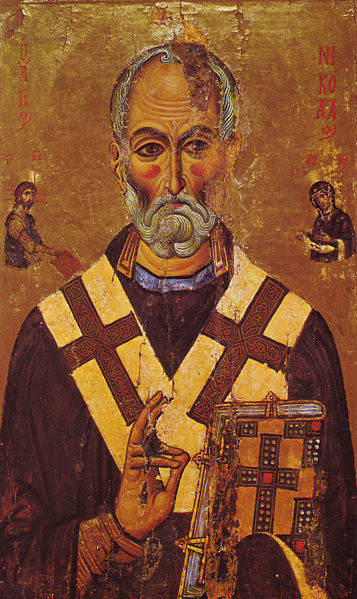
St. Nicholas
from Saint Catherine's Monastery
via Wikimedia


8: Who brings presents to children in December?
  1. Santa Claus does.
  2. The Christ Child does.
  3. Father Christmas does.
  4. Saint Nicholas does.
  5. Sinterklaas does.
  6. All of the above.


9: When is Christmas in Australia and New Zealand?
  1. In fall.
  2. In winter.
  3. In spring.
  4. In summer.
  5. In autumn.
  6. All year long.


10: What do Americans do on Christmas Eve?
  1. Go on dates with their special girlfriends or boyfriends.
  2. Visit the families of their special girlfriends or boyfriends.
  3. Go to Church for religious services.
  4. Go to Church for a Christmas party or dance.
  5. Stay home with their families.
  6. Work overtime.
  7. Different people do different things at different times.


Answers:

1: (E). See #5.

2: (B), although it varies in some traditions.

3: (A). (The evening before Christmas.)

4: (E). Fir trees are common elements of many religions and traditions, but had no particular meaning in early Christianity.

5: (E). There is no record of the actual date. According to some people, the accounts in the Bible indicate a date in late summer or early fall. Other people suggest a date in spring. The arguments for winter are considered rather weak.

6: (E). Although there is no record of the date, there are many records of arguments about the date, and of the official declaration of the state religion by Emperor Constantine.

7: (C): "Christ Mass".

8: (F).
  1. Santa Claus is a common tradition around the world.
  2. The Christ Child (Christkind) is a German and Austrian tradition.
  3. Father Christmas is a tradition in the UK.
  4. Saint Nicholas is a tradition in much of Europe, and the origin of Santa Claus.
  5. Sinterklaas is a tradition in Holland and Belgium. The red suit he wears is the origin of Santa's red suit.
  6. There are many more similar traditions in many countries.
9: (B). December is summer in the southern hemisphere. However, some people do try to remember the Christmas spirit all year long.

10: (G). The most common thing is to try to spend time with family.

PTA English December Topic -- Christmas, of Course

Well, it goes without saying that we will talk about Christmas.
お解りのことだと思いますが、クリスマスが今回の話題となりました。

We plan for a present exchange, so please bring an inexpensive gift. Please don't spend more than ¥1,000 on it.
プレゼント交換が計画に入っています。1,000円以下の、お金がかからない程度のプレゼントを持ってきていただければ、と思っています。

Of course, homemade (handmade) is fine!
お手作りならもちろん、うれしい。

Unfortunately, I haven't had time to make anything, so I'll bring something cheap.
恐れ入りますが、私は時間に迫って手作りなどに手を付けれなかったので、何らかの安いものを持ってきます。

[homemade/handmade: 自家製、手作り]

And it looks like we'll repeat the parlor game we tried last time. (The notes for the last lesson are here.)
前回の「パーラーゲーム」(居間遊び?)をまた今回もやって見るようです。(前回のノートはここにあります。)

[JMR201701031415:
If I have time, I'll introduce a Christmas themed parlor game or two.
時間の余裕があれば、クリスマス関連のゲームも紹介してあげましょう。
(Nothing but games. :-)
The notes for December 2016's Christmas party are finally up.
2016年12月のクリスマスパーティのノートをやっとう投稿できました。
Sorry it took so much time. Maybe we played too many games.
こんな時間かかって、ごめんなさい。ゲームが多すぎたかも知りません。

]

[JMR201612132252: 

I put together a Christmas quiz of sorts in English. I don't know yet if I'll use it in class.
何らかの英語のクリスマスクイズを作りました。授業に使うかどうかはまだ決めていません。

]

[JMR201612161326:

Here's a little dialog about the date of Christmas that I started last year and finished today:
去年、クリスマスの日付を特定することについて、対話例を書き始めたけど、今日なんとか完成しました。

]


I posted a very few notes on Christmas a few years ago, here.
数年前のことでしたが、クリスマスについて少しだけの参考になるようなものを投稿しました。ここです。

[JMR201612131512: 

Finally got the Christmas notes from last year up. Sorry it took so long. And you might be interested in the errata about winter solstice.
やっと去年のクリスマスノートを投稿しました。こんなに時間がかかってすみませんでした。そして、冬至についての誤報訂正も面白く思っていただけるかも知れません。 

]


2015-12-25

December 18th Notes -- Christmas Phrases and Vocabulary

[This was actually posted on December 13, 2016. Sorry about the delay.
実際に投稿したのはその送る年の 2016年 12月 13日でした。こんなに遅れてしまってごめんなさい。]

Notes from the lesson:

... don't really know ...
はっきりと解らない、実際は知らない
when A (名詞) was B (動詞の過去分詞)
A が B になった時点(とき・ところ)
We don't really know when Jesus was born.
イエスさまがいつお産まれになった日時は実は知りません。
druid
ドルイド(旧ヨーロッパの先住民の宗教者。樅の木を崇拝行事に取り入れたそうです。)
Hanukkah
ハヌカー(ユダヤ教の冬季節行事、クリスマスに似た行事だと思われることもあります。)
Christ Mass => Christmas
キリストのミサ(Crīstesmæsseなど)
winter solstice (mea culpa)
冬至(冬の一番短い日)
equal
等しい
spring
春、泉、バネ、飛び跳ねる
late summer - early fall
夏の下旬から秋野初旬
cloud
雲
crowd
人込み
go along with the crowd
流行に沿う(人気に従う)
service
行事(奉仕、給仕など)
get up
起きる、立ち上がる
giddy up
馬を追い立てる語
meme
流行っている発想
applesauce
アップルソース(煮たりんごのすり潰し)
way
行く道(行き方、やり方、風習)
get in the way
邪魔になる(道に入って、その道を防ぐ)
get out of the way
退く(道を防いだものが退くように)
toss
軽く投げる
tossed salad
(トストサラダ)菜っ葉を手で切って、ネギや他の野菜と一緒に軽く和えたサラダ
ドレシングを会えるのが基本と言うこともある。
all is well
全ては良し
... is well ('s well)
するのが望ましい
swell
素晴らしい(俗語)
jingle bell rock
シャカシャカ鈴のロックミュジック
Jingle Bell Rock (lyrics might be here, video might be here)
クリスマス季節に流行ったジングルベルに因んだ歌詞あるポピュラーソング
swing
(ブランコ)ブラブラさせる、垂れて揺さぶる、振る
jingle
鈴などのシャカシャカチリンチリン音、チリンチリン鳴る
ring
(鈴や鐘が)鳴る
bell shape
鐘の形(ジングルベルが鈴のようなものです。)
snowin' => snowing
雪が降っている状態
blowin' (blowing) up fun
楽しみを吹き起こして
bushel
果物収穫用のカゴ、凡そ36リットルの量
bushels of fun => lots of fun
楽しみいっぱい
glide
滑るように進む(そりやグライダーのように)
slide
滑る(滑り台で滑り降りるように)
I'm glad I can glide.
力入れず、行きたいところへグライドできるのが嬉しい。
(発音してみて下さい。)
wind (ウィンド)
風
wind (ワインド)
ねじり回す、ねじり廻る
sock hop
靴下で踊るダンスパーティー
stocking
長い靴下
stocking feet
靴下のまま(の足)、靴履かず